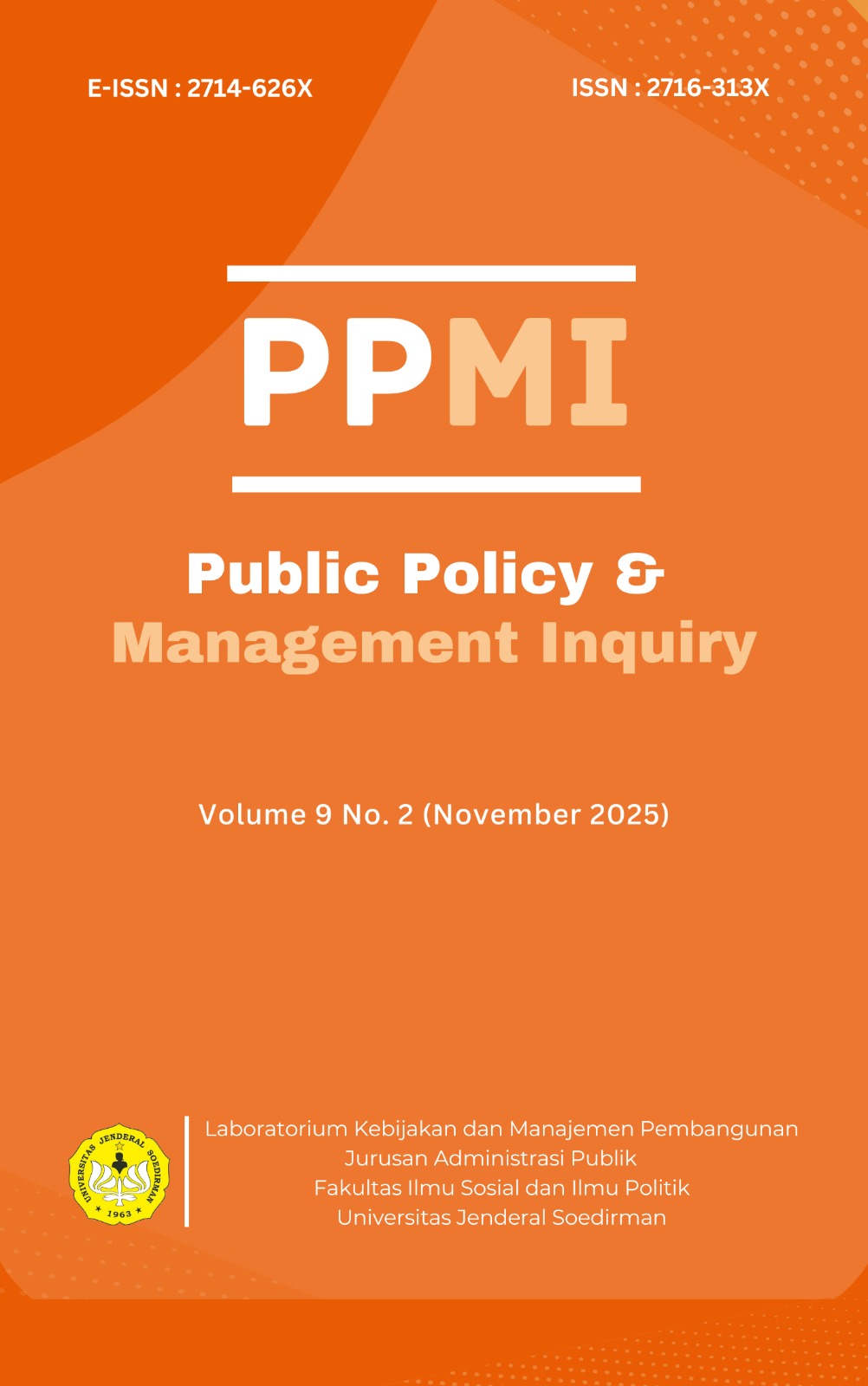
Editorial: Navigating Uncertainty Through Policy Transformation
Abstract
This editorial explores policy transformation as a strategic framework for navigating the era of structural uncertainty defined by rapid sociopolitical, economic, and technological changes. In Indonesia, this situation is exacerbated by geographical disaster vulnerability and significant challenges to the integrity, neutrality, and professionalism of the State Civil Apparatus (ASN) during political transitions. The sources indicate that rigid, sectoral policy models have proven insufficient to address complex issues such as rural poverty, regional inequality, and the multidimensional pressures of urbanization in cities like Surabaya. Furthermore, the universal application of Western Public Administration (WPA) often lacks cultural legitimacy and fails to address grassroots realities because it neglects Indonesia's unique social and institutional contexts. To bridge the gap between policy design and implementation reality, this editorial proposes a framework of embedded autonomy and collaborative governance where bureaucrats are designed as autonomous actors who are institutionally obligated to network and negotiate with local communities. This approach is exemplified by successful village potential management through Village-Owned Enterprises (BUMDes), which strengthen local economies while building social trust. Ultimately, effective policy transformation requires the restoration of the merit system to protect the bureaucracy from politicization and the development of non-Western paradigms that prioritize microsociety and human capital as the primary drivers of public service innovation
References
Ansell, C. and Gash, A. (2016). Collaborative Governance in Theory and Practice. Journal of Public Administration Research and Theory. Journal of Public Administration Research and Theory, 18(4).
Bjärstig, T., Johansson, J., Mancheva, I., & Sandström, C. (2024). Collaboration as a policy instrument in public administration: Evidence from forest policy and governance. Environmental Policy and Governance, 34(5). https://doi.org/10.1002/eet.2099
Brinkerhoff, D. W., & Brinkerhoff, J. M. (2011). Public-private partnerships: Perspectives on purposes, publicness, and good governance. Public Administration and Development, 31(1), 2–14. https://doi.org/10.1002/pad.584
Carelli, D., & Pierre, J. (2024). When the cat is away: How institutional autonomy, low salience, and issue complexity shape administrative action. Public Administration, 102(1). https://doi.org/10.1111/padm.12912
Chris Ansell, & Alison Gash. (2007). Collaborative Governance in Theory and Practice. Journal of Public Administration Research and Theory, 18.
Emerson, K., Nabatchi, T., & Balogh, S. (2012). An integrative framework for collaborative governance. Journal of Public Administration Research and Theory, 22(1). https://doi.org/10.1093/jopart/mur011
Glazyev, S. Y. (2022). Global Transformations from the Perspective of Technological and Economic World Order Change. AlterEconomics, 19(1). https://doi.org/10.31063/altereconomics/2022.19-1.6
Gupta, A. K., & Lamsal, B. P. (2023). FROM TRADITIONAL TO INNOVATIVE PUBLIC SERVICE: A REVIEW OF PARADIGM SHIFTS. In Public Administration Issues (Issue 6). https://doi.org/10.17323/1999-5431-2023-0-6-137-156
Iacovino, N. M., Barsanti, S., & Cinquini, L. (2017). Public Organizations Between Old Public Administration, New Public Management and Public Governance: the Case of the Tuscany Region. Public Organization Review, 17(1). https://doi.org/10.1007/s11115-015-0327-x
Jafarova, R. F. K. (2025). Implementation of State Governance in the Liberated Territories as One of the Manifestations of Azerbaijani Constitutionalism. Futurity Economics&Law, 5(1). https://doi.org/10.57125/fel.2025.03.25.04
Kandel, A., Pandit, R., Ghimire, S., & Paudel, A. (2025). NEW PUBLIC MANAGEMENT: HISTORICAL DEVELOPMENT AND THEORETICAL FOUNDATION. International Journal of Agriculture, Environment and Bioresearch, 10(03). https://doi.org/10.35410/ijaeb.2025.5984
Kim, Y. (2021). Searching for Newness in Management Paradigms: An Analysis of Intellectual History in U.S. Public Administration. American Review of Public Administration, 51(2). https://doi.org/10.1177/0275074020956678
Koerner, B., Sushartami, W., & Spencer, D. M. (2024). An assessment of tourism policies and planning in Indonesia. Tourism Recreation Research, 49(6). https://doi.org/10.1080/02508281.2023.2214030
Kurniawati, W. O. I., & Saprudin, S. (2025). Ethics in Indonesian Government Bureaucracy: Theoretical Foundations, Historical Evolution, and Contemporary Case Studies. Journal of Asian Multicultural Research for Social Sciences Study, 6(1). https://doi.org/10.47616/jamrsss.v6i1.588
Lamawuran, Y. D., Ratumakin, P. A. K. L., Molan, K. S. H., Tokan, F. B., & Susu, M. T. (2025). Gelu Epen Culture: Rationality Of The Local Wisdom-Based People’s Market Revitalization Program. JURNAL TRIAS POLITIKA, 9(1). https://doi.org/10.33373/jtp.v9i1.7546
Li, F., & Diao, Z. (2024). New urbanization construction and city economic resilience-based on multi-period DID tests for 278 cities. Heliyon, 10(17). https://doi.org/10.1016/j.heliyon.2024.e36605
MacKinnon, D. (2002). Rural governance and local involvement: Assessing state - community relations in the Scottish Highlands. Journal of Rural Studies, 18(3). https://doi.org/10.1016/S0743-0167(01)00048-1
Mao, Y. (2021). Political institutions, state capacity, and crisis management: A comparison of China and South Korea. International Political Science Review, 42(3). https://doi.org/10.1177/0192512121994026
Rahmadhani, P., Perwita, A. A. B., & Ramsi, O. (2025). Building Regional Readiness Indonesia’s Leadership in Enhancing AHA Centre’s Disaster Response Capabilities. International Journal of Humanities, Education, and Social Sciences, 3(3). https://doi.org/10.58578/ijhess.v3i3.6951
Saleh, C., Hendrik, E., Zauhar, S., & Nuh, M. (2021). COLLABORATIVE GOVERNANCE IN PUBLIC ADMINISTRATION PERSPECTIVE. Journal of Southwest Jiaotong University, 56(6). https://doi.org/10.35741/issn.0258-2724.56.6.58
Schnell, S., & Gerard, C. (2023). From Bureaucrats to Entrepreneurs to Networkers, Advocates, and Empaths: Reappraising Human Resources Management Ideals and Practices in Public Administration. Review of Public Personnel Administration, 43(4). https://doi.org/10.1177/0734371X221117283
Sitorus, I. Y., Charloq, & Gultom, P. (2025). Multidimensional Determinants of Poverty and Regional Clustering in North Sumatra, Indonesia: A Factor and Cluster-Based Analytical Approach. South Asian Journal of Social Studies and Economics, 22(7). https://doi.org/10.9734/sajsse/2025/v22i71073
Suripto, S., Keban, T. Y., & Pamungkas, S. H. A. (2021). Indigeneous Public Administration: A Review and Deconstruction of the Idea, Concept, and Theory of Government and Governance. Jurnal Borneo Administrator, 17(3). https://doi.org/10.24258/jba.v17i3.932
Sutangsa, S. (2024). Peran Aparat Administrasi Publik dalam Pencegahan Korupsi: Suatu Analisis Perspektif. The World of Public Administration Journal. https://doi.org/10.37950/wpaj.v5i2.1888
Turner, M., Prasojo, E., & Sumarwono, R. (2022). The challenge of reforming big bureaucracy in Indonesia. Policy Studies, 43(2). https://doi.org/10.1080/01442872.2019.1708301
Wijaya, M. P. H., Pearce, P., & Moens, G. (2019). Reforming Bureaucracy in Indonesia: The Legal Challenges of Reorganisation. Int’l Trade & Bus. L. Rev.
Wijaya, S. S. (2022). Apakah Partisipasi Masyarakat Dapat Mencegah Korupsi ? Jurnal Ilmu Administrasi Negara ASIAN (Asosiasi Ilmuwan Administrasi Negara), 10(2). https://doi.org/10.47828/jianaasian.v10i2.118
Yang, Z., Cao, Y., & Du, J. (2023). The Impact of New Urbanization Construction on Sustainable Economic Growth of Resource-Based Cities. Environmental Science and Pollution Research, 30(43). https://doi.org/10.1007/s11356-023-29171-8

This work is licensed under a Creative Commons Attribution 4.0 International License.