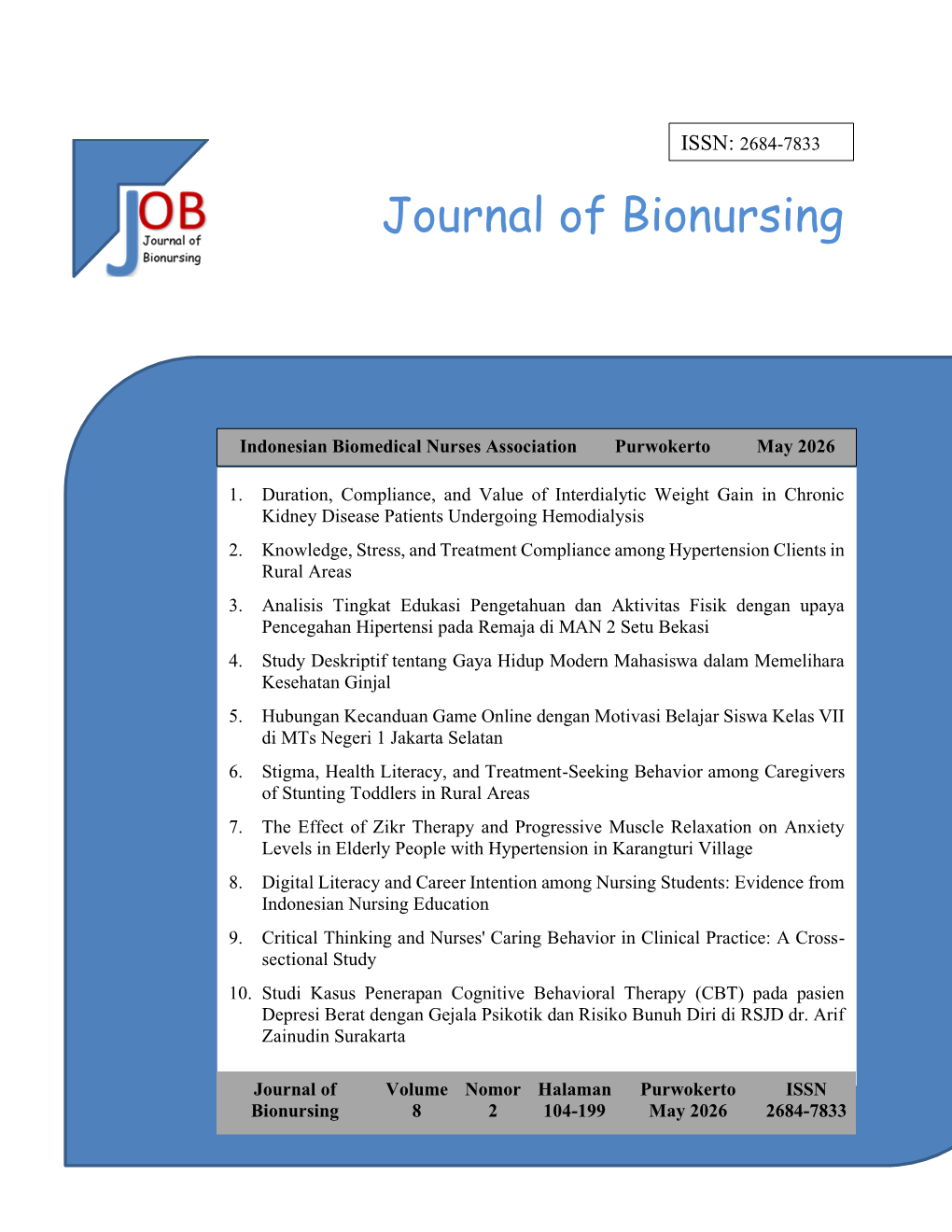
Studi Kasus Penerapan Cognitive Behavioral Therapy (CBT) pada pasien Depresi Berat dengan Gejala Psikotik dan Risiko Bunuh Diri di RSJD dr. Arif Zainudin Surakarta
Abstract
Introduction: Severe depression with psychotic symptoms is a mental disorder that increases the risk of suicide due to feelings of hopelessness, worthlessness, and loss of hope. Cognitive Behavioral Therapy (CBT) is one of the psychotherapeutic interventions that is effective in reducing symptoms of depression and suicidal ideation.
Objective: To analyze the application of CBT in patients with severe depression exhibiting psychotic symptoms and a risk of suicide.
Method: A case study of a 31-year-old male patient treated at RSJD dr. Arif Zainudin Surakarta after a suicide attempt. Data were obtained thru interviews, observations, mental status examinations, and medical record reviews. CBT was administered in five sessions over three days to identify and modify negative thoughts and enhance adaptive coping.
Results: After the intervention, the patient was able to recognize negative automatic thoughts, develop more rational thinking, improve the ability to express feelings, and use more adaptive coping strategies. The frequency of suicidal thoughts decreased, and hope and more realistic life plans emerged.
Conclusion: CBT contributes to the reduction of suicidal ideation and the improvement of coping abilities in patients with severe depression and psychotic symptoms.
References
Berardelli, I., Sarubbi, S., Rogante, E., Hawkins, M., Cocco, G., Erbuto, D., Lester, D., & Pompili, M. (2019). The role of demoralization and hopelessness in suicide risk in schizophrenia: A review of the literature. Medicina, 55(5), 200. https://doi.org/10.3390/medicina55050200
Dini, W., Susila, C., Susanti, Y., Putri, E., & Wardani, I. Y. (2023). Application Of Cognitive Behaviour Therapy (CBT) And Family Psuchoeducation (FPE) In Patients At Risk Of Suicide. Jurnal Perawat Indonesia, 7(2), 1398–1406.
Donohue, M. R., & Luby, J. (2020). Depression. In J. B. Benson (Ed.), Encyclopedia of infant and early childhood
Hill, C. E. (2020). Helping skills: Facilitating exploration, insight, and action. American Psychological Association.
Horwitz AG., Berona J., Czyz EK., et al, (2017), Positive and Negative Expectations of Hopelessness As Longitudinal Predictors of Depression, Suicidal Ideation, and Suicidal Behavior in High-Risk Adolescent, Suicide and Life-Threatening Behavior, doi:10.1111/sltb.12273
Panjaitan, R. U., Wardani, I. Y., Nasution, R. A., Primananda, M., & Arum, D. O. R. S. (2023). Keeratan Keluarga dan Kemampuan Pemecahanan Masalah Berhubungan dengan Ide Bunuh Diri pada Mahasiswa. Jurnal Keperawatan, 15(3), 1045–1052. https://doi.org/10.32583/keperawatan.v15i3.149
PPNI. (2017). Standar Diagnosis Keperawatan Indonesia:Definisi dan Indikator Diagnostik: Vol. III (Revisi) (1st ed.). PPNI.
PPNI. (2018). Standar Intervensi Keperawatan Indonesia: Definisi dan Tindakan Keperawatan: Vol. II (1st ed.). PPNI.
PPNI. (2019). Standar Luaran Keperawatan Indonesia: Definisi dan Kriteria Hasil Keperawatan: Vol. II (1st ed.). PPNI.
Rothschild, A. J. (2013). Challenges in the treatment of major depressive disorder with psychotic features. Schizophrenia Bulletin, 39(4), 787–796. https://doi.org/10.1093/schbul/sbt046
Sander, L. B., Beisemann, M., Doebler, P., Micklitz, H. M., Kerkhof, A., Cuijpers, P., et al. (2023). The effects of internet-based cognitive behavioral therapy for suicidal ideation or behaviors on depression, anxiety, and hopelessness in individuals with suicidal ideation: Systematic review and meta-analysis of individual participant data. Journal of Medical Internet Research, 25, e46771. https://doi.org/10.2196/46771
Stuart GW, (2009), Principles and Practice of Psychiatric Nursing, Ed. 9th, Mosby, Elsevier.
Tarrier, N., Taylor, K., & Gooding, P. (2015). Cognitive behavioral therapy for suicidal behaviors: Improving patient outcomes. Vascular Health and Risk Management, 11, 423–430. https://doi.org/10.2147/VHRM.S63724
Zhao, M., & Wang, P. (2025). Effectiveness of cognitive behavioral therapy in reducing suicidal ideation and influential factors in patients with major depressive disorder: A systematic review and meta-analysis. Psychology and Clinical Health Journal, 14(5), 734–748. https://doi.org/10.1002/pchj.70034

This work is licensed under a Creative Commons Attribution-NonCommercial-NoDerivatives 4.0 International License.


 Kampus keperawatan unsoed
  Published By Jurusan Keperawatan FIKES UNSOED
 bionursing@unsoed.ac.id