|
|
|
Author Guidelines
Author Guidelines
Jurnal Keperawatan Soedirman
Download author guideline in English or Indonesia
Short description
Jurnal Keperawatan Soedirman is a scientific journal devoted to research and development publications in the field of nursing, covering basic research in nursing, nursing management, emergency and critical nursing, medical-surgical nursing, mental health nursing, maternity nursing, pediatric nursing, gerontological nursing, community nursing, family nursing, nursing education, and complementary and alternative medicine (CAM) in nursing. Articles can be original articles, systematic reviews, and meta-analyses in nursing fields.
Participants
Researchers from Universities, Research Institutes, and Hospitals.
Abstracting and Indexing
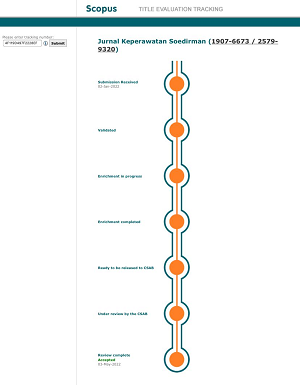
- Scopus (indexed since March 2022)
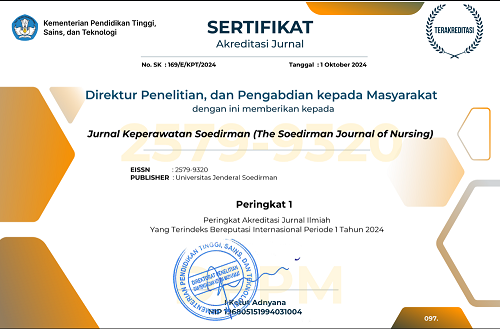
- SINTA (Science and Technology Index, Ministry of Higher Education, Science, and Technology of the Republic of Indonesia)
- Directory of Open Access Journals (DOAJ)
- ASEAN Citation Index (ACI)
- EBSCO
- Garuda (Garba Rujukan Digital)
- Google Scholar
- Crossref (DOI prefix 10.20884)
Writing Guidelines
Coverage
Jurnal Keperawatan Soedirman covers all areas of nursing, including basic research in nursing, nursing management, emergency and critical nursing, medical-surgical nursing, mental health nursing, maternity nursing, pediatric nursing, gerontological nursing, community nursing, family nursing, nursing education, and complementary and alternative medicine (CAM) in nursing.
Type of article
Jurnal Keperawatan Soedirman accepts original research articles, systematic reviews, and meta-analyses. Case studies and case reports are not accepted. Generally, the full research article and systematic review do not exceed 12 pages (3000-5000 words). The article should be written in English. A copy of institutional review board (IRB) approval is required for any research published in Jurnal Keperawatan Soedirman. The number of IRB approval should be provided in the methods section.
Journal Publishing Fee
Jurnal Keperawatan Soedirman (JKS) charges an Article Processing Charge (APC) only after a manuscript has been accepted for publication. Authors are not required to pay any submission fee. The current APC rates are IDR 4,000,000 per accepted article for Indonesian authors and USD 250 per accepted article for international authors.
A partial APC discount is available for manuscripts whose first author is affiliated with an institution outside Indonesia. The discount must be requested during submission and cannot be applied after the manuscript has been accepted. Two copies of the printed journal will be sent to the author.
For full details, including the waiver policy and payment procedure, please see the Author Fees page.
When submitting the manuscript, the corresponding author must complete and sign the Author Statement form, which covers originality, no publication or consideration elsewhere, authorship agreement, no conflict of interest, and agreement to publish the article under the Creative Commons Attribution 4.0 International License (CC BY 4.0), with the authors retaining the copyright. The form can be downloaded here. Please sign it over an IDR 10,000 stamp duty (meterai), scan it, and upload it as a supplementary file during submission.
Suggested Reviewers
When submitting the manuscript, authors must suggest at least two (2) potential reviewers by writing their details in the Comments for the Editor box in Step 1 of the submission process. For each suggested reviewer, please provide the full name, affiliation, institutional email address, and Scopus ID or ORCID iD.
Suggested reviewers must be experts in the field of the manuscript and must not have a conflict of interest with the authors. They should not be from the same institution as any of the authors and should not have co-authored a publication with any of the authors in the last three years. Please use institutional email addresses rather than personal email addresses. The editor is not obliged to invite the suggested reviewers, and the final selection of reviewers remains the decision of the editor.
Preparation of the Manuscript
The manuscript is prepared using the JKS template in word processing software (e.g. Microsoft Word). The article is written in English, typed in Arial Narrow 12-point font (tables in 10-point font), single-spaced, justified, with a first-line indent of 0.5, on A4 paper with 3.5 cm margins on all sides.
Article Structure
The article structure used for primary sessions uses bold no-numbering (eg Abstract, Introduction), and more detailed sessions can use numbering 1,2, and 3 or a, b, and c.
Title
The title section consists of:
1. The title of the article (not exceeding 20 words).
2. Author's name and its affiliation (institution). The author responsible for the correspondence, marked "*", which is then under affiliation given the "*" email address"
Abstract
The abstract is written in English only, as one unstructured paragraph of no more than 250 words. The abstract contains a summary of the research's background, objectives, methods, key results, and main conclusions. Citations and abbreviations should be avoided in the abstract.
Keywords
Keywords are written in English, containing 3-5 keywords in alphabetical order. Abbreviations and ambiguous words should be avoided. Choose words that help readers find the article when searching.
Background
The introduction contains the objectives and hypotheses of the study accompanied by appropriate rearranges. Detailed literature writing and the conclusion of research results should be avoided in this section.
Methods
This section contains tools and materials specifically used in the research as well as the workings of research methods undertaken. The workings that already existed in previous research, should be included in the reference and only modification if da which needs to be written in detail.
Results
Results should reveal and explain the results of the research that has been done in the form of tables or pictures obtained.
Discussion
The obtained result is then discussed by comparing it with the results of previous research. Other sources of references (of the previous research) are aimed at strengthening the argumentation of the results of research that has been done. The sources of references in the discussion must meet the scientific requirements (journal, textbook, or proceedings).
Conclusion and Recommendation
Conclusions from the results of research conducted delivered briefly and clearly
Acknowledgment
This section can be expressed thanks to institutions, experts, or other bodies that play an important role in the implementation of research undertaken.
Attachment
If necessary to deliver important supporting data, it can be attached in a separate session of the main article. Attachments can be video, images, computer simulation files, or data sets.
Math formula
Simple mathematical formulas should use a slash (/) to replace a horizontal line, for example, X / Y.
Picture
The displayed image or picture must be clear, at least 300 dpi resolution. Images created with programs such as Microsoft Word® or Microsoft Powerpoint® can be delivered as-is.
Image Title
The title is written underdrawings, middle averages, capital letters at the beginning of a sentence. Avoid unusual use of abbreviations. The title pointer of the image is thick (for example, Figure 1. Influence Z on Y under X).
Table
The table is given a horizontal line in the header (first row) and the end of the table only, with no vertical lines.
Table title
The title is written above the table, left flat.
Library
Type
80% referenced library is a journal (primary source) with a maximum age of 10 years.
Writing Library
Writing Library refers to APA (American Psychological Association) 6th edition. When using the library management software (Reference Manager), the style can be downloaded on each website:
Mendeley: http://csl.mendeley.com/
Example of writing
In writing
Single author
In one developmental study (Smith, 1990), children learned ...
or
In the study by Smith (1990), primary school children ...
or
In 1990, Smith's study of primary school children ...
Plural authors
The first citation: Masserton, Slonowski, and Slowinski (1989) state that ...
Next citation: Masserton et al. (1989) state that ...
Some references in a sentence
Several studies (Jones & Powell, 1993; Peterson, 1995, 1998; Smith, 1990) suggest that ...
Writing in the References
Book:
Strunk, W., & White, E. B. (1979). The guide to everything and then some more stuff. New York, NY: Macmillan.
Gregory, G., & Parry, T. (2006). Designing brain-compatible learning (3rd ed.). Thousand Oaks, CA: Corwin.
Book chapter:
Bergquist, J. M. (1992). German Americans. In J. D. Buenker & L. A. Ratner (Eds.), Multiculturalism in the United States: A comparative guide to acculturation and ethnicity (pp. 53-76). New York, NY: Greenwood.
Journal with DOI:
Fatoni, A., Numnuam, A., Kanatharana, P., Limbut, W., Thammakhet, C., & Thavarungkul, P. (2013). A highly stable oxygen-independent glucose biosensor based on a chitosan-albumin cryogel incorporated with carbon nanotubes and ferrocene. Sensors and Actuators B: Chemical, 185(0), 725-734. DOI:10.1016/j.snb.2013.05.056
Journal without DOI (DOI not available):
Hermawan, D., Yatim, I. M., Ab Rahim, K., Sanagi, M. M., Ibrahim, W. A. W., & Aboul-Enein, H. Y. (2013). Comparison of HPLC and MEEKC for Miconazole Nitrate Determination in Pharmaceutical Formulation. Chromatographia, 76(21-22), 1527-1536.
Hamfi, A. G. (1981). The funny nature of dogs. E-journal of Applied Psychology, 2(2), 38 -48. Retrieved from http://ojs.lib.swin.edu.au/index.php/fdo
Conference
Zusfahair, Ningsih, D. R., & Kartika, D. (2015). The potency of Amylase Producing Bacteria in the Liquid Waste of Tapioca Factory. Paper presented at the 1st Pharmacy International Conference, Purwokerto, Indonesia.
Online Newspaper:
Becker, E. (2001, August 27). Prairie farmers reap conservation's rewards. The New York Times. Retrieved from http://www.nytimes.com
Encyclopedia:
Brislin, R. W. (1984). Cross-cultural psychology. In R. J. Corsini (Ed.), Encyclopedia of psychology (Vol. 1, pp. 319-327). New York, NY: Wiley.
Submission Preparation Checklist
As part of the submission process, authors are required to check off their submission's compliance with all of the following items, and submissions may be returned to authors that do not adhere to these guidelines.
- The submitted manuscript has not been published before.
- Registered scripts are typed in Open Office or Microsoft Word document formats.
- If any URL address of the reference should be written.
- The text follows the JKS template: Arial Narrow 12-point font, single-spaced; uses italics instead of underlining (except for URL addresses); and all illustrations, figures, and tables are placed within the text at the appropriate points, not on separate pages.
- Writing styles follow the terms listed in the Author Guidelines
- If you register a section requiring peer review, Instructions in Ensuring a Blind Review are followed.
Copyright Notice
Authors who publish in Jurnal Keperawatan Soedirman retain the copyright of their articles and grant the journal the right of first publication. Articles are published open access under the Creative Commons Attribution 4.0 International License (CC BY 4.0), which allows others to share and adapt the work for any purpose, provided that appropriate credit is given to the authors and to the original publication in this journal.
Privacy Statement
The names and email addresses entered in this journal site will be used exclusively for the stated purposes of this journal and will not be made available for any other purpose or to any other party.
 Download Template








 Kampus keperawatan unsoed
 Published By Jurusan Keperawatan FIKES UNSOED
 jks@unsoed.ac.id